Do businesses with websites get more reviews?
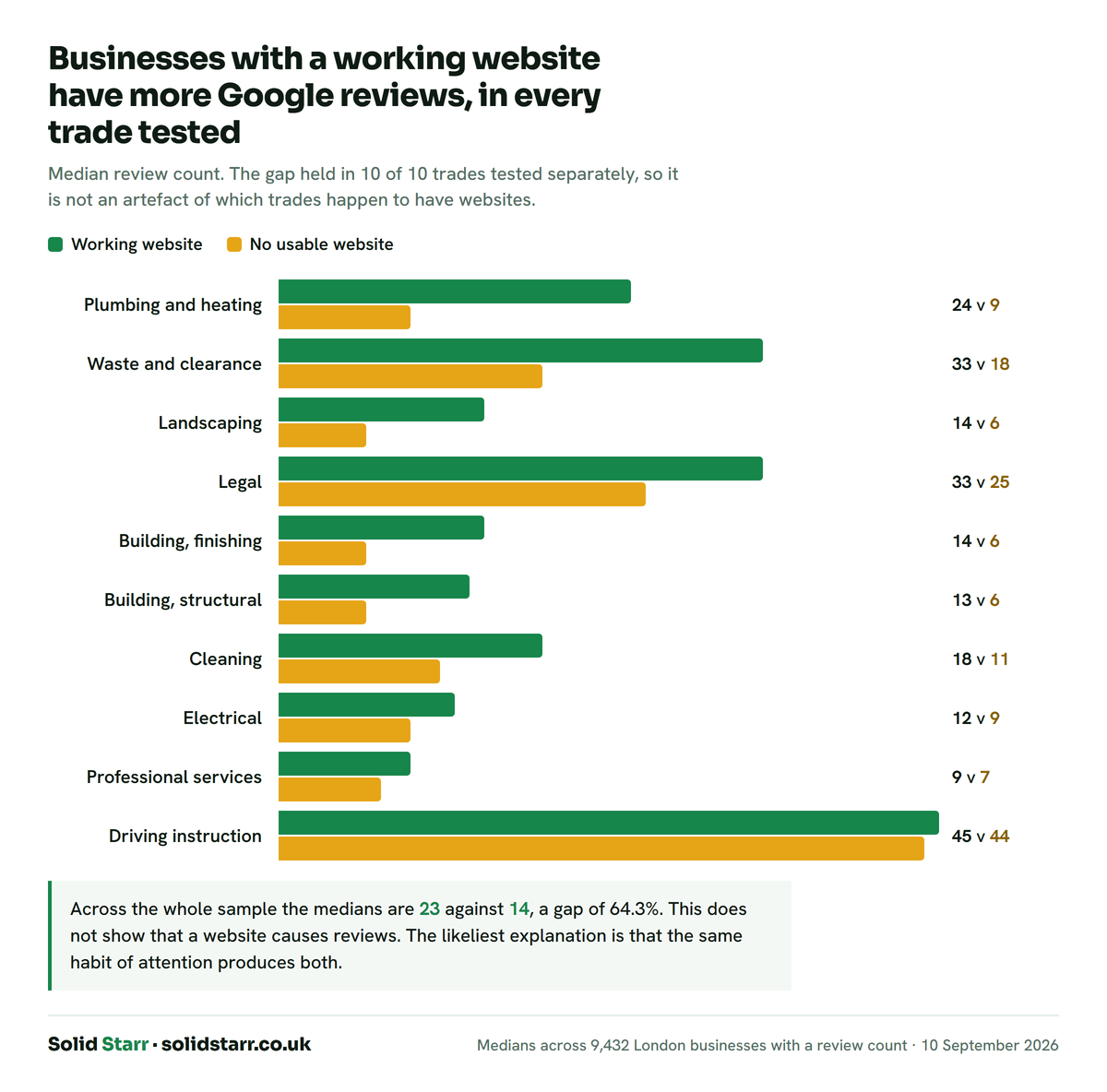
London businesses with a working website have a median of 23 Google reviews. Those without have 14. That is 64% more, and the gap holds inside every single trade we tested. What it does not do is prove the website caused it.
This is a follow up to our study of 10,862 London businesses. Of those, 8,783 had both a checked website status and a Google review count, which is what this piece is built on.
Medians throughout, not averages. One business in this dataset has 25,747 reviews, and an average would describe that outlier rather than the ordinary business you actually care about.
It holds in every trade
A pooled figure can lie. If the trades that naturally attract lots of reviews also happen to be the ones that keep their websites working, you would see a gap in the overall number that does not exist inside any single trade. So we ran the same comparison separately within each trade that had enough businesses on both sides.
| Trade | Working site | No usable site |
|---|---|---|
| Plumbing and heating | 24 | 9 |
| Waste and clearance | 33 | 18 |
| Landscaping | 14 | 6 |
| Legal | 33 | 25 |
| Building, finishing | 14 | 6 |
| Building, structural | 13 | 6 |
| Cleaning | 18 | 11 |
| Electrical | 12 | 9 |
| Professional services | 9 | 7 |
| Driving instruction | 45 | 44 |
Ten out of ten. In plumbing and heating the difference is close to threefold, 24 against 9. Landscaping and both building categories run at more than double.
The exception is the interesting part
Driving instruction shows 45 against 44, which is no difference worth reporting. It is also the trade with the highest review counts overall on both sides.
That fits something you can observe without any data. A driving instructor's relationship with a customer ends at a test result, which is a natural moment to ask, after months of contact. The reviews arrive regardless of anything else the business does. Where the review comes naturally, the website makes no difference to it. Where it does not, something else has to do that work.
What this does not prove
It would be easy, and commercially convenient for us, to present this as evidence that building a website gets you more reviews. It is not. Three explanations fit this pattern equally well, and nothing in this data separates them:
- The same habit drives both. A business that keeps a website working is the sort of business that also keeps its Google listing current and asks customers for reviews. The website is a symptom of the habit rather than the cause of the reviews.
- Size and age drive both. Larger, longer established businesses tend to accumulate more reviews and are also more likely to have paid someone to build and maintain a site.
- The website genuinely helps. More people find the business, more become customers, and more of those leave reviews.
Our honest guess is that the first explanation carries most of the weight, and that is not the flattering one for a web design business to land on. The practical implication runs the other way from the sales pitch: if you have to choose, ask for reviews first. They are a direct ranking factor in local search, and a website is not.
Method and limits
Google review counts were read from public business listings at the same time as the website check. Businesses were compared in two groups: a working site, or no usable site, meaning broken, parked, social only, or absent. Sites that blocked automated checks were excluded from both groups rather than guessed at. Trade level comparisons required at least 40 businesses on each side.
- Review counts in this dataset run from 1 to 25,747. Businesses with no reviews at all are not represented, so this describes businesses that have at least started.
- We could not control for business age or size, because the incorporation date is not reliably present. That is the biggest weakness here, and it is why the causation section above is written the way it is.
- Review counts are a snapshot and only ever go up.
- Nothing here measures review quality. A business with 40 reviews at 3.2 stars is in a worse position than one with 12 at 4.9.
Using these figures
You are welcome to quote any number on this page, in print or online, including commercially. All that is asked is a link back to this page so readers can check the method.
Suggested citation: Solid Starr Solutions (2026), London Trade Websites Study,
https://solidstarr.co.uk/websites-and-google-reviews-study.html
Press or research enquiries: hello@solidstarr.co.uk
Questions about this study
Do websites cause more Google reviews?
This data cannot answer that. It shows a strong association: London businesses with a working website have a median of 23 Google reviews against 14 for those without, a gap of 64%. But three explanations fit that pattern equally well, and nothing in the data separates them. Anyone claiming a website causes reviews is going beyond the evidence.
How big is the difference in Google reviews?
Across 8,783 London businesses with a review count, the median for a business with a working website is 23 reviews against 14 for a business with no usable site. The gap holds inside 10 of 10 trades tested separately, so it is not caused by some trades attracting more reviews than others.
Which trade shows the biggest difference?
Plumbing and heating, where businesses with a working site have a median of 24 reviews against 9 without, nearly three times as many. Landscaping and both building categories show a similar pattern. Driving instruction is the exception, at 45 against 44, which is effectively no difference at all.
Should I get more reviews or build a website first?
Reviews, almost always. For most local trades more people arrive through Google Maps than through any website, and reviews are a direct ranking factor in local results in a way a website is not. If you can only do one thing this month, ask your last ten customers for a review.
Is your site one of the broken ones?
Send me the link and I will tell you straight what a visitor actually sees. No charge and no pitch if it is fine.